- Overuse: Repetitive knee bending from activities like running, jumping, cycling, or climbing stairs.
- Muscle Imbalances: Weakness in the quadriceps (thigh muscles), glutes, or tightness in surrounding muscles (hamstrings, IT band).
- Biomechanical Issues: Problems with foot mechanics (e.g., overpronation), hip alignment, or knee alignment.
- Sudden Increase in Activity: Too much, too soon, overloading the joint.
- Pain around, behind, or just below the kneecap.
- Pain worsens with activity (running, squatting, jumping, stairs).
- Pain after prolonged sitting with bent knees (theatre sign).
- Clicking or grinding sensations in the knee.
While understanding the underlying causes with a healthcare professional is crucial, providing the right external support can be a vital part of managing symptoms and supporting your knee’s recovery.
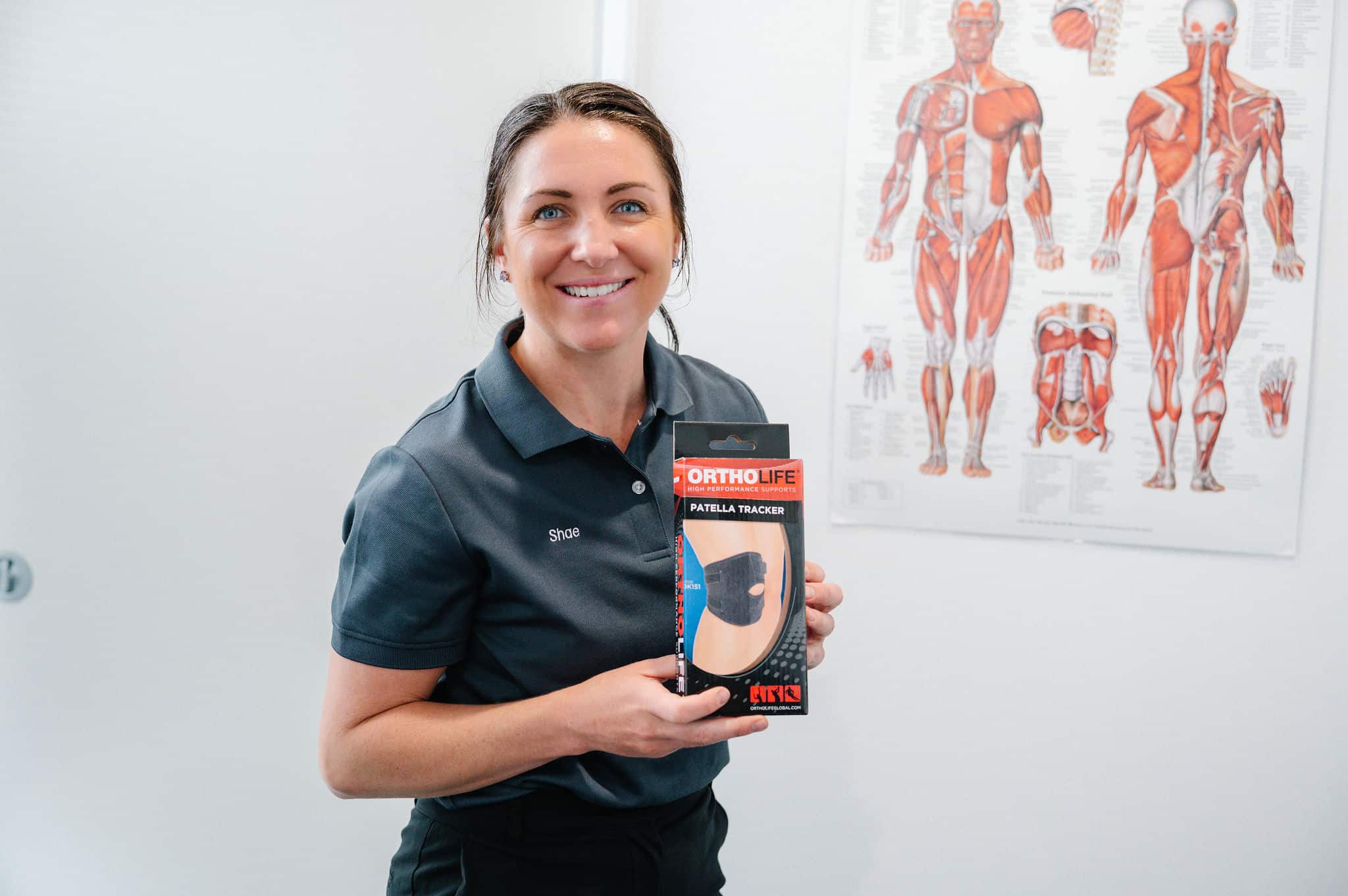
Our physiotherapy-endorsed knee supports offer targeted relief and support for Patellofemoral Syndrome, aiding your recovery. These braces provide several key benefits:
- Improved Patellar Tracking & Pain Relief: Specific designs like patellar buttresses or straps gently guide the kneecap into its optimal path. This directly reduces friction and alleviates pain around and behind the kneecap, especially during bending.
- Compression and Swelling Management: Gentle, consistent compression helps manage swelling around the kneecap, contributing to reduced pain and a more comfortable feel.
- Enhanced Comfort During Activity: By supporting the kneecap and reducing discomfort, our braces allow you to stay active with greater comfort, preventing constant knee aggravation during daily tasks or training.
- Proprioceptive Feedback: Braces provide continuous sensory input, enhancing your body’s awareness of knee position. This encourages mindful movement patterns and better muscle activation, further protecting your kneecap.
- Overall Support & Confidence: Beyond specific patellar support, the general compression and stability offer a comforting sense of security. This reduces apprehension, empowering you to move with greater confidence.
Don’t let Patellofemoral Syndrome keep you from running, hiking, or enjoying everyday activities. Providing your knee with the right external support can be a powerful tool in managing pain, improving kneecap tracking, and regaining your comfort and confidence.
Ready to find the relief and support your knee deserves? Explore our range of physiotherapy-endorsed knee supports today and take a step towards a more comfortable and active you.
- American Academy of Orthopaedic Surgeons (AAOS). (n.d.). Patellofemoral Pain Syndrome. Retrieved June 8, 2025, from https://orthoinfo.aaos.org/en/diseases–conditions/patellofemoral-pain-syndrome/
- Dye, S. F. (2005). The Knee as a Biologic Transmission with an Envelope of Function: A New Paradigm for Understanding Knee Joint Loading and Symptom Generation. Clinical Orthopaedics and Related Research, 436, 10-17. https://doi.org/10.1097/01.blo.0000165819.82570.5a
- Esculier, J. F., Bouyer, L. J., Dubois, B., & Roy, J. S. (2018). Is wearing a brace beneficial for runners with patellofemoral pain syndrome? A systematic review. Journal of Orthopaedic & Sports Physical Therapy, 48(9), 724–731. https://doi.org/10.2519/jospt.2018.7891
- MacDonald, R., & MacIntyre, J. G. (2018). Patellofemoral pain syndrome. British Journal of Sports Medicine, 52(14), 934–935. https://doi.org/10.1136/bjsports-2018-099419
- Mayo Clinic. (n.d.). Runner’s knee (patellofemoral pain syndrome). Retrieved June 8, 2025, from https://www.mayoclinic.org/diseases-conditions/runners-knee/diagnosis-treatment/drc-20353883
- Powers, C. M., & Barton, C. J. (2014). The Role of Movement System Impairment Syndromes in Patellofemoral Pain. Journal of Orthopaedic & Sports Physical Therapy, 44(9), 651-660. https://doi.org/10.2519/jospt.2014.542